

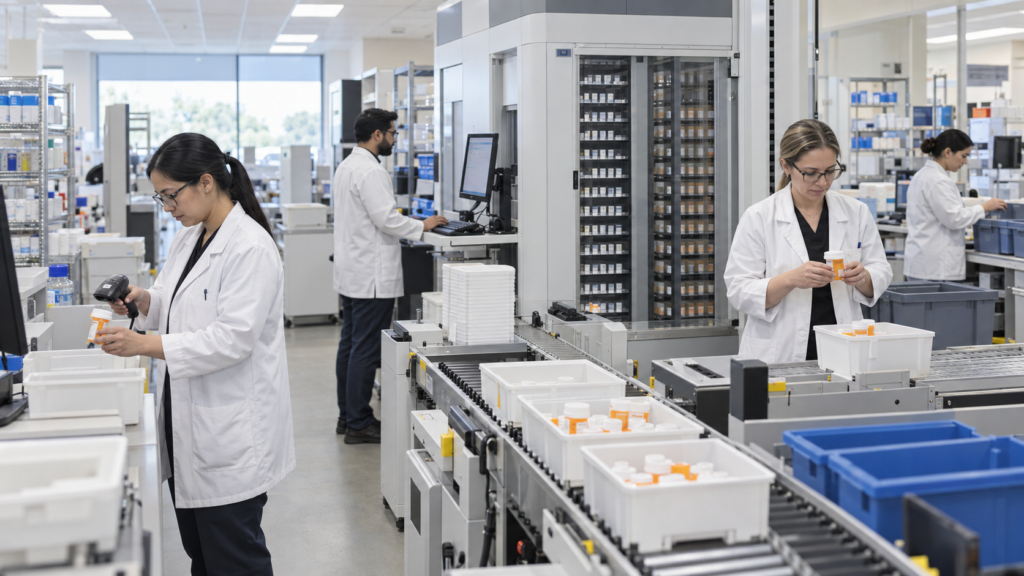
A central fill pharmacy is a licensed, high-volume dispensing facility that fills prescriptions on behalf of community pharmacies. It does not serve walk-in patients. It has no retail counter and no waiting room. Its only function is to process, fill and package prescriptions accurately and at scale.
Central fill pharmacy services address the structural problem facing Canadian community pharmacy today. Prescription volume is rising, qualified staff are scarce, and pharmacists are being asked to deliver more clinical care than ever. Moving routine repeat dispensing to a centralized, automated facility relieves that pressure without moving the patient relationship out of the store.
In traditional in-store filling, every step happens behind the counter. The prescription arrives, and typically an assistant enters it, counts it, and labels it, and the pharmacist verifies it. Every one of those steps competes with phone calls, counselling, injections and third-party billing questions.
Central fill separates the mechanical work from the clinical work. Repeat prescriptions are transmitted to the central facility. Automated equipment fills and labels them. Sealed, patient-specific packages then return to the originating store.
PharmaChoice Canada has Member central fill pharmacies that can be accessed by members.
Prescription Intake and Processing
The process begins in the community pharmacy. A refill request arrives through the store’s pharmacy management system (PMS), an e-prescribing feed, an automated refill line or a patient app. Staff identify which prescriptions qualify for central fill under the pharmacy’s own criteria.
Eligible prescriptions are then transmitted electronically to the central facility. Patient profile data, insurance information and directions travel with the order.
Clinical review remains a pharmacist responsibility. Depending on the provincial model, the initial therapeutic check may occur at the community pharmacy, at the central fill site, or both. Drug interaction screening, dose verification and therapy duplication checks are completed before filling begins. Nothing enters the automation until a pharmacist has authorized it.
Centralized Medication Filling
Inside the facility, automated dispensing systems do the physical work. High-speed counting equipment, vial-filling robotics and pouch or blister packaging lines handle the volume that would otherwise occupy technicians in each store.
Labelling is generated from the same prescription record, which removes transcription risk. Each vial or package is matched to the patient using barcode verification at multiple points along the line.
Quality assurance is built into the workflow rather than added at the end. Weight-based checks confirm quantity. Imaging systems confirm tablet identity. Sampling protocols and audit logs document every fill. Completed orders are sorted by store, sealed in tamper-evident totes and staged for transport. While it does reduce some errors, it can introduce others. Robust systems are in place to reduce medication packaging errors, but logistical errors do happen.
Delivery Back to the Community Pharmacy
Transportation is scheduled, not ad hoc. Most operations run daily courier routes with defined cut-off times.
Route design matters. Density determines cost, and distance determines turnaround. Rural and remote stores need longer lead times and more local inventory.
When the tote arrives, the store pharmacist performs the final check. They confirm the right drug, the right patient and the right directions. They then release the prescription and counsel the patient at pickup. The professional relationship stays exactly where it was.
Which Prescriptions Are Best Suited for Central Fill?
Maintenance Medications
Chronic disease therapy is the natural fit. Antihypertensives, statins, oral antidiabetics, thyroid replacement, inhaled maintenance therapy and many psychiatric medications are dispensed month after month with no change in drug, dose or directions.
These prescriptions are predictable. They can be scheduled ahead, filled in batches and synchronized to a common refill date. Routine refills for stable patients often make up most of a pharmacy’s volume and almost none of its clinical complexity.
High-Volume Medications
The second category is defined by frequency rather than duration. Every pharmacy has a list of 100 to 200 molecules that account for most of its script count. Standardized directions and common package sizes make these ideal candidates for automation.
Concentrating them centrally produces two gains. Purchasing improves through volume, and shelf space is freed for products that need to be on site.
Prescriptions That Typically Remain In-Store
Central fill is not intended to handle everything. Acute prescriptions stay in the store. A patient with an ear infection or a new pain prescription needs the medication today, not tomorrow.
Anything urgent or subject to a same-day expectation is filled locally. Cold-chain products and short-dated items are usually excluded. Some pharmacies operate dedicated central fill locations that specialize in compounding, including a number within our banner. As NAPRA has improved compounding standards, many community pharmacies may not have the specialized facilities, equipment, or capacity required to prepare more complex compounds on-site, requiring it to be sent off to be done centrally.
Controlled substances depend on jurisdiction. Some provincial regulators permit centralized filling of narcotics and controlled drugs under specific security and record-keeping conditions. Others do not. Confirm the rules with your provincial college before building these into a model. 
Benefits of a Central Fill Pharmacy
Improved Workflow Efficiency
One of the clearest benefits is the volume of routine dispensing work that can be moved out of the pharmacy. Depending on the central fill model and level of adoption, a significant share of refill prescriptions may be handled centrally, helping reduce the in-store dispensing burden and giving pharmacy teams more capacity for patient care and other services.
Staff allocation improves as a result. Technicians move from counting to patient intake, insurance resolution, inventory and assisting with clinical programs. The dispensary stops being the constraint on everything else the pharmacy wants to do.
More Time for Patient Care
Time is the resource central fill actually creates. Pharmacists who are not verifying repeat fills all afternoon can deliver the services that patients and payers increasingly expect.
That includes medication reviews, minor ailment assessments, immunizations, smoking cessation support, point-of-care testing and follow-up with patients whose adherence is slipping. These services carry professional value and, in most provinces, billable fees. They are difficult to schedule when the dispensary is at capacity.
Enhanced Prescription Accuracy
Accuracy improves for structural reasons. Central fill sites have fewer interruptions, standardized procedures and consistent equipment. Barcode verification is enforced at every handoff rather than depending on vigilance during a rush. The community pharmacist still performs the final professional check, so the process carries more verification points than a typical in-store fill.
Greater Scalability for Pharmacy Networks
For multi-store operators, central fill is a growth mechanism. Adding a location no longer requires proportional dispensing capacity in that location. A smaller footprint with fewer staff can support meaningful volume.
Service also becomes more consistent across the banner. Every store follows the same fill standards, the same labelling format and the same packaging presentation. Patients receive the same experience whether they visit the flagship or the newest store.
How Central Fill Supports Independent Pharmacies
Managing Labour Challenges
Recruitment remains one of the toughest problems in Canadian community pharmacy. Vacancies in smaller centres can stay open for months. Relief coverage is expensive when available at all.
Central fill does not solve the shortage. It reduces exposure to it. A store that has outsourced most of its refill volume can operate with a leaner team without compromising service or safety, provided a central fill facility is fully staffed itself.
Expanding Clinical Services
Independent pharmacies compete on relationships and access, not price. Expanded scope of practice plays directly to that strength.
Pharmacists who are freed from the fill queue can build assessment clinics, chronic disease programs and vaccination services. These offerings differentiate an independent from a large chain and create revenue that is not tied to dispensing margin.
Reducing Operational Pressure
Peak periods become survivable. Monday mornings, post-holiday surges and respiratory season no longer overwhelm the dispensary because most repeat volume has already been handled off-site.
Lower in-store dispensing demand also reduces overtime, staff burnout and turnover. Those savings rarely appear on a dispensing report, but owners notice them.
The Technology Behind Central Fill Pharmacies
Automation and Robotics
High-speed counting devices, robotic vial handling and multi-dose pouch packagers form the mechanical core. Throughput ranges from a few thousand prescriptions per day in a regional facility to far higher in national operations.
Prescription Management Software
The software layer routes prescriptions, applies eligibility rules and tracks each order through fill, verification, packing and delivery. Integration with each store’s pharmacy management system is the single most important technical requirement. Poor integration creates manual work that cancels out the efficiency gain.
Inventory Management Systems
Perpetual inventory, automated replenishment and demand forecasting keep the facility stocked and the stores lean. Forecasting also supports advance filling for synchronized refill dates.
Barcode Verification and Quality Control
Barcode scanning at picking, filling, labelling and packing creates a documented chain of custody. Imaging and weight verification confirm the contents. Full audit trails support both internal quality review and regulatory inspection.
Challenges and Considerations
Transportation and Turnaround Times
Logistics is the primary operational risk. A missed courier run means prescriptions are not on the shelf when patients arrive. Contingency plans, buffer inventory and clear cut-off communication are all necessary. Geography sets practical limits, and stores beyond reliable next-day courier range may not be viable participants.
Inventory Coordination
Splitting inventory between central and local sites requires discipline. Stores need enough stock for acute and same-day work without duplicating what the facility already holds. Getting this wrong ties up capital or creates stockouts.
Communication Between Central Fill and Community Pharmacies
Exceptions need a clear path. Prescription clarifications, therapy changes, cancelled orders and damaged shipments all require defined escalation. Shared dashboards and order status visibility prevent staff from calling to ask where a prescription is.
Regulatory and Privacy Requirements
Central fill is regulated provincially. Requirements differ on facility licensing, pharmacist responsibility, labelling content, record retention and which drug schedules may be filled remotely. Any model must be validated with the relevant college before launch, and revalidated when it expands across provincial lines.
Privacy obligations apply throughout. Patient information moves between organizations, which means the Personal Information Protection and Electronics Documents (PIPEDA) and provincial health privacy legislation both come into play. Encryption, access controls, information-sharing agreements and breach protocols are baseline expectations, not optional additions.
Ideal Pharmacy Models
Multi-store groups benefit most. Shared volume across locations justifies the fixed cost of automation and facility operation.
Independent banners and buying groups can achieve the same result collectively. Several independents contracting with one central fill provider gain the same economics without individual capital investment.
Growing regional chains are strong candidates as well, particularly those adding locations faster than they can recruit pharmacists.
Key Factors to Evaluate
Assess these before committing:
- Prescription volume. Total scripts and the refill percentage determine whether the model pays back. Refill-heavy books perform best.
- Geographic footprint. Store clustering drives courier cost and turnaround feasibility.
- Clinical service goals. Central fill only pays off if reclaimed hours are redirected into billable or strategic care.
- Staffing capacity. Current vacancies, turnover and relief costs quantify the labour benefit.
- Technology infrastructure. Pharmacy management system compatibility, network reliability and integration capability decide how smoothly the model runs.
Model the economics honestly. Include courier costs, software integration, staff retraining and the transition period when both workflows run in parallel.
FAQ’s
What is a central fill pharmacy?
A central fill pharmacy is a licensed high-volume facility that fills prescriptions on behalf of community pharmacies. It does not serve patients directly. Filled prescriptions are returned to the originating store for final pharmacist verification and patient pickup.
How does central fill differ from traditional pharmacy dispensing?
In traditional dispensing, every step happens in the store. With central fill, the counting, labelling and packaging occur off-site using automated systems. The community pharmacist retains clinical review, final verification and patient counselling.
What types of prescriptions can be filled through a central fill pharmacy?
Maintenance medications for chronic conditions and high-volume standardized prescriptions are the best fit. Acute prescriptions, urgent fills, compounds and cold-chain products generally stay in-store. Eligibility for controlled substances depends on provincial regulations.
How does central fill help pharmacists spend more time with patients?
It removes a large share of repetitive refill work from the dispensary. Those reclaimed hours can be redirected to medication reviews, minor ailment assessments, vaccinations, adherence support and follow-up care.
The Future of Central Fill Pharmacy
Automation will keep advancing. Newer equipment handles more dosage forms, including unit-dose packaging and specialty products that once required manual work.
AI-assisted workflow optimization is emerging in demand forecasting, refill synchronization, route planning and workload balancing across facilities. The goal is fewer exceptions and tighter turnaround, not replacing professional judgment.
Demand for pharmacist-led clinical care will keep growing. Health systems under strain are looking to pharmacies for accessible primary care. That demand cannot be met while pharmacists spend most of the day on mechanical dispensing.
Central fill is one of several operating models independent owners may consider as pharmacy practice evolves. PharmaChoice Canada supports independent pharmacy owners through purchasing programs, vendor relationships, pharmacy services resources, marketing, retail programs, and recruitment support. Members continue to retain local ownership and control. Contact us to learn more about the PharmaChoice member-owned model.